
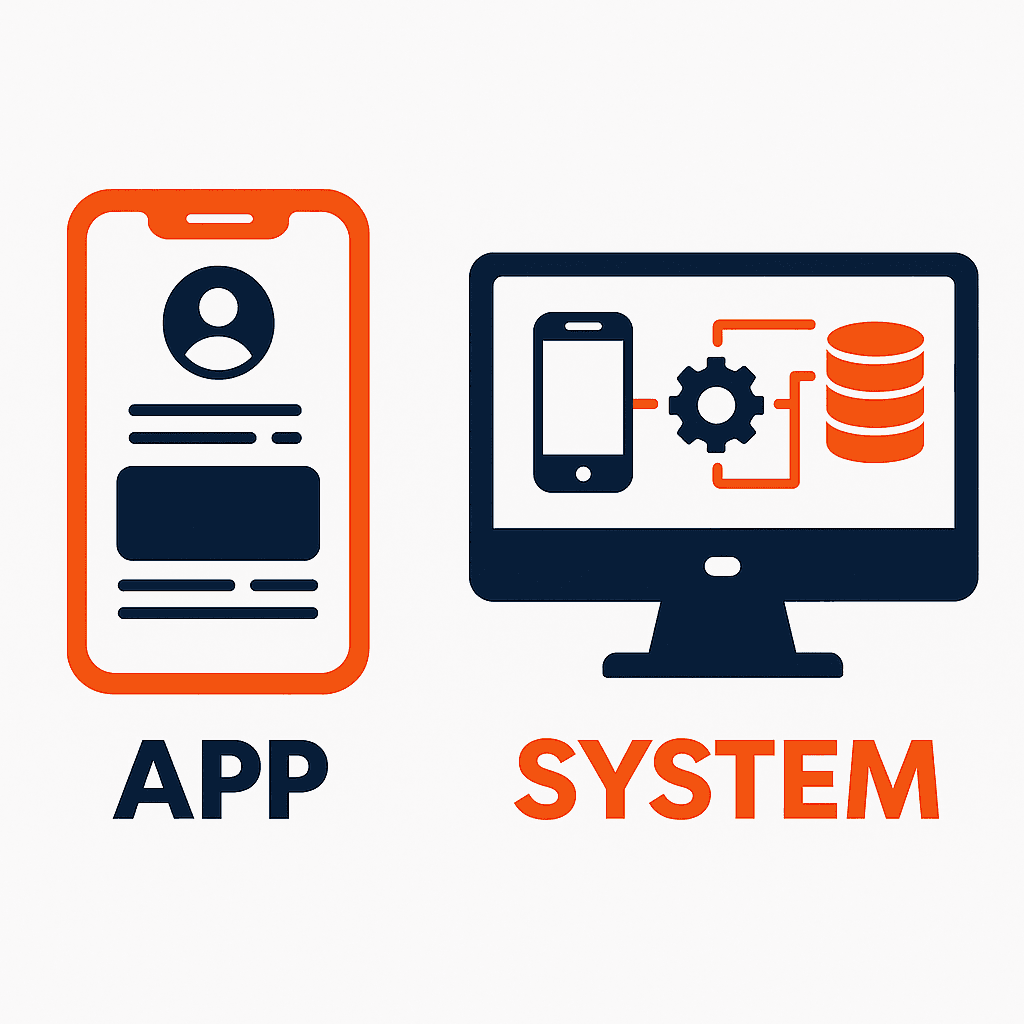
Building an App vs. Building a System: What Most Founders Miss (And Why It Costs Them Later)
You have a great startup idea. You hire a developer or agency. A few months later, you have a shiny new app. Great, right?
But fast forward a year: new features are hard to add, performance lags, different parts of your business don’t “talk” to each other, and scaling feels like rebuilding from scratch.
What happened? You built an app, not a system. This is one of the most common (and costly) mistakes non-technical founders make.
The App Trap: Quick Wins, Long-Term Pains
Most MVPs are rushed. Founders want something visual, usable, and launchable. That’s fair—but it usually means:
- One big codebase with tightly coupled parts
- No clear architecture or separation of concerns
- No modularity or reuse
- Business logic mixed with UI code
- Features built for the now, not the next
This is fine for version 1. But when your user base grows or your product vision expands, these shortcuts turn into bottlenecks.
What Is a “System”?
A system is more than just the app your users see. It’s a structured collection of modular services that work together to deliver value—cleanly, flexibly, and reliably.
A good system might include:
- A frontend app (React, Flutter, etc.)
- A backend API (Node.js, Django, etc.)
- A database (PostgreSQL, Firebase, etc.)
- Background job workers
- Notification or email services
- Admin dashboards
- Integrations with third-party tools
- Secure authentication
- Clear API contracts and documentation
Why It Matters (Early On)
Founders often ask: “Can’t we just fix this later?”
You can, but it gets exponentially harder. Here’s what goes wrong without systems thinking:
| Problem | Impact |
|---|---|
| Spaghetti code | Developers quit or slow down |
| Hardcoded flows | Can’t support new user types or pricing models |
| No data pipelines | Reporting is manual or unreliable |
| Tech debt | Rebuilding takes months, not weeks |
| No integrations | Growth hacks or partnerships stall |
Signs You’re Building a System (Not Just an App)
- You separate frontend from backend
- You have a clear database schema
- You use environment variables and configs
- You can plug in new modules (e.g., Stripe, Zapier, AI) without breaking the core
- You have staging/test environments
- You document endpoints and services
Real Example
A B2B SaaS founder launched an MVP using a single-page app with Firebase for everything. It worked well… until she needed audit logs, role-based access, and custom client portals. Her dev team spent 3 months rebuilding what could’ve been structured better from day one—with less than 2 extra weeks of planning.
So What Should Founders Do Differently?
- Understand your long-term use cases: Will you need user roles? APIs? Reporting?
- Ask your developers how modular the build is: Can parts be replaced later?
- Use modern frameworks and best practices: e.g., Next.js + Prisma + Supabase or Django + DRF + React.
- Plan for growth: Will it be easy to add new user types, dashboards, or integrations?
Conclusion
Building an MVP app is easy. Building a sustainable, scalable system is smart. Non-tech founders who think just one step ahead—modularity, architecture, reusability—save time, money, and pain down the road.
Your product isn’t just an app. It’s a system in the making. Build like it.
 Turn Idea Into a Digital Product
Elevating Customer Experience.


© Copyright 2024 By Infatech